For a small bit of Italy, Tuscany has produced a ridiculous number of famous people. The Italian language, more or less. The telescope pointed at Jupiter. Tosca. Pinocchio. Even the word America.
Here’s my who’s who of famous Tuscans who weren’t (mainly) painters. The artists get a post of their own. I’ve grouped them into writers, musicians, and a mixed bag of scientists, statesmen and saints.
Writers
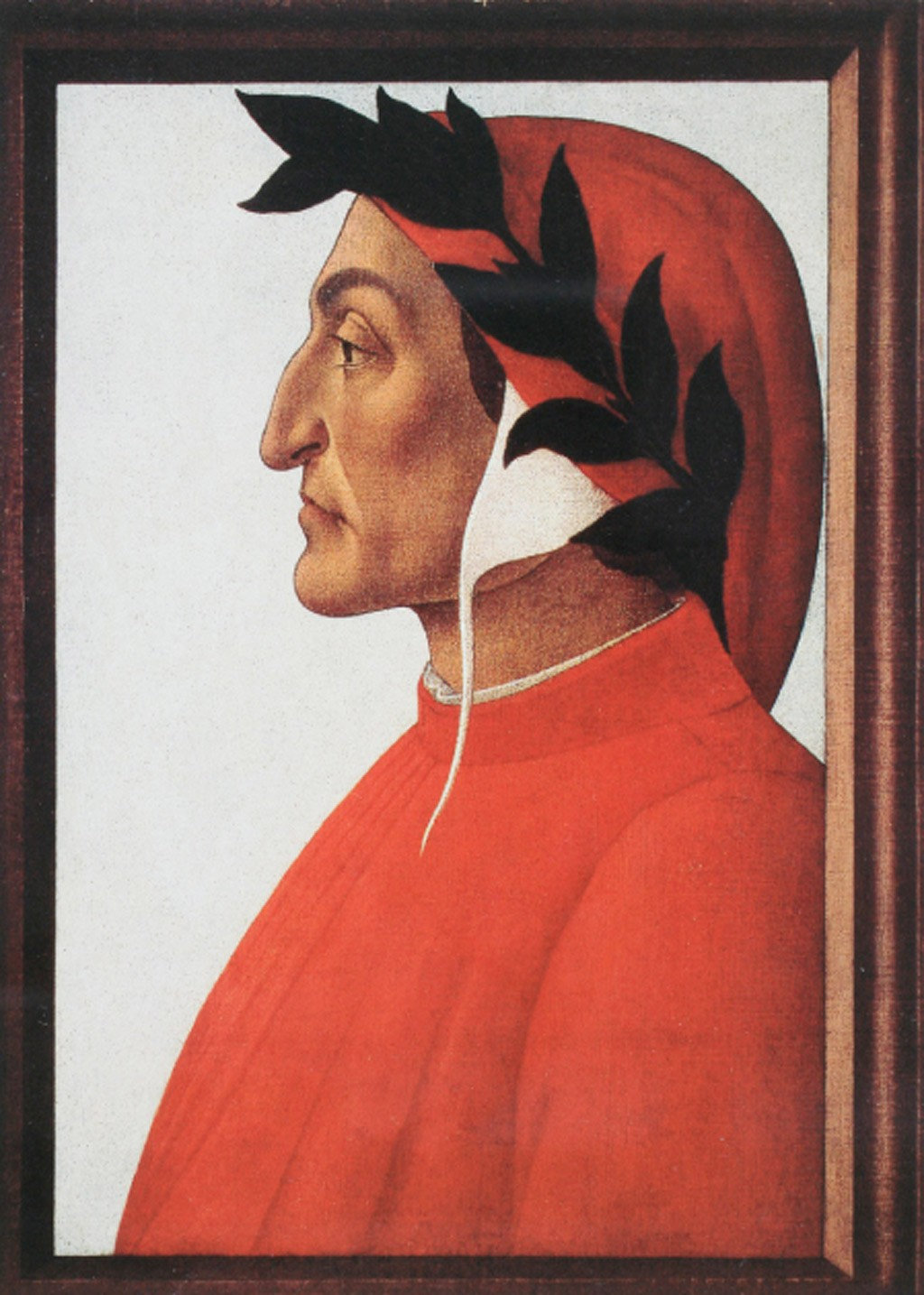
Dante Alighieri (1265–1321), Florence
Tuscany gave Italy its three great medieval writers: Dante, Petrarch and Boccaccio. Dante was born in Florence in 1265. He called his great poem the Commedia. The ‘Divina’ was added later. He wrote it in Italian rather than Latin, which did a huge amount to shape the Italian language. Boccaccio wrote the first life of Dante. Dante also wrote on politics, philosophy and poetry itself.

Petrarch (1304–1374), Arezzo
Francesco Petrarca was born in Arezzo, but his family moved to Avignon when he was young. His father made him study law. He’d rather have been reading Latin, and in the end he was. He travelled all over Europe hunting for old manuscripts and is often called the father of Humanism. He saw a woman called Laura in the church of St Clare in Avignon, and wrote poems about her for the rest of his life. They’re collected in the Canzoniere, written in Italian, though most of his other work was in Latin.
Giovanni Boccaccio (1313–1375), Florence
Boccaccio grew up in Florence, worked in banking with his father, and studied law. Neither suited him. He’s remembered for the Decameron: a hundred stories told by ten young people sheltering from the plague outside Florence. Like Dante, he wrote it in Italian. He and Petrarch became friends, and their letters helped lay the ground for Humanism.
Guittone d’Arezzo (c. 1230–1294) and Bonagiunta Orbicciani (c. 1230–c. 1300)
Two early poets. Guittone was born near Arezzo, was exiled after 1256 for his Guelf sympathies, and became the leading voice of Tuscan poetry before Dante. After joining a religious order he turned from love poems to religious ones.
Bonagiunta came from Lucca. Around forty of his poems survive. He belongs to the older, Siculo-Tuscan school, and turns up in Dante’s Purgatorio, canto 24, where it’s Bonagiunta who gives the ‘dolce stil novo’, the sweet new style, its name.
Pietro Aretino (1492–1556), Arezzo
Aretino was a shoemaker’s son from Arezzo who took the town’s name as his own. He became a famous poet, playwright and letter-writer, best known for his savage attacks on the powerful. Some of it looked a lot like blackmail. He had to leave Rome in 1524 and ended up in Venice, living very well indeed.
Carlo Collodi (1826–1890), Florence
Carlo Lorenzini was born in Florence. He took his pen name from Collodi, his mother’s village, where he spent part of his childhood. He started as a journalist for Italian unification and moved on to children’s books. Le avventure di Pinocchio came out in instalments and as a book in 1883. It’s been translated into hundreds of languages. He died suddenly in Florence in 1890, before Pinocchio became the global star he is now.

Collodi is just along the valley from Pescia. It’s a tumble of houses above the Garzoni garden, with Pinocchios in every shop window. Take the kids to the Parco di Pinocchio. See my Tuscany with kids post.

Francesco Domenico Guerrazzi (1804–1873), Dario Niccodemi (1874–1934) and Dino Provenzal (1877–1972), Livorno
Livorno punches above its weight. Guerrazzi was a writer and Risorgimento patriot, often in prison or exile for it. His best-known novel is L’assedio di Firenze (The Siege of Florence), from 1836. Niccodemi grew up in Buenos Aires, wrote plays in Paris, and came home to huge success with comedies like Scampolo. His theatre company put on the first performance of Pirandello’s Six Characters in Search of an Author in 1921. Provenzal was a schoolteacher in fourteen towns across Italy, and a writer and critic best known for his work on Dante.
Music
Guido d’Arezzo (c. 991–after 1033), Arezzo
A Benedictine monk who trained at the abbey of Pomposa, then taught the choir at Arezzo cathedral. He developed the musical staff and the ut-re-mi way of teaching singers to sight-read, the ancestor of do-re-mi, and wrote it all up in a treatise called the Micrologus. Every music lesson you ever had owes him something.
Luigi Boccherini (1743–1805), Lucca
A cellist and composer from a musical Lucca family. His father sent him to Rome to study at 13. He ended up in Spain, working for the king’s brother, the Infante Don Luis, and wrote hundreds of works. Lots of chamber music, with the cello given far more to do than usual.
Pietro Alessandro Guglielmi (1728–1804), Massa
An opera composer from Massa, trained in Naples. He worked in Dresden, Brunswick and London as well as Italy, and finished as music director at St Peter’s in Rome. His comic operas were known for their fun.
Giacomo Puccini (1858–1924), Lucca
Puccini came from a Lucca family with generations of church musicians behind him. His father died when he was five. Seeing Verdi’s Aida in Pisa in 1876 is said to have set him on the road to opera. He studied in Milan with Amilcare Ponchielli and Antonio Bazzini, and then wrote La Bohème (1896), Tosca (1900), Madama Butterfly (1904) and Turandot, which he left unfinished.

From the 1890s he lived at Torre del Lago, on Lake Massaciuccoli. His villa there is a museum, and he’s buried in it. His birthplace in Lucca is the Puccini Museum. There’s a Puccini festival at Torre del Lago every summer. And don’t miss the family home at Celle, in the hills above Lucca. See my Celle dei Puccini post.

Pietro Mascagni (1863–1945), Livorno
Puccini’s contemporary and, for a while, his rival. Mascagni studied in Livorno, then hit the jackpot with his first big opera, Cavalleria rusticana, in 1890. It launched the verismo style: real people, real passions, no gods or kings. L’amico Fritz and Iris followed. Livorno’s seafront Terrazza Mascagni is named after him.
Scientists, statesmen and saints
Galileo Galilei (1564–1642), Pisa
Galileo was born in Pisa, traditionally in a house on Via Giusti. The family moved to Florence, and he was schooled at the abbey of Vallombrosa before studying at the University of Pisa. He taught at Pisa and then Padua, worked on motion and mechanics, and improved the telescope. With it he saw the four big moons of Jupiter and the phases of Venus.

His support for Copernicus, with the Sun at the centre, got him into trouble with the Roman Inquisition, and he was forced to recant in 1633. He spent his last years under house arrest at Arcetri, just outside Florence. He’s buried in Santa Croce, and the Museo Galileo in Florence has his instruments.
Niccolò Machiavelli (1469–1527), Florence
Machiavelli served the Florentine Republic as a diplomat and official. When the Medici came back in 1512 he lost his job, was tortured, and retired to his small farm outside Florence. There he wrote The Prince, the book that turned his name into an adjective. He’s buried in Santa Croce too.

Francesco Guicciardini (1483–1540), Florence
A Florentine lawyer, statesman and friend of Machiavelli. He governed papal provinces for the Medici popes, and spent his last years writing his History of Italy, covering 1494 to 1534. It’s still one of the key sources for the period.
Lorenzo the Magnificent (1449–1492), Florence
The most famous Medici. Banker, politician, diplomat and poet, and patron to Botticelli, Verrocchio and the young Michelangelo. He’s buried in the New Sacristy at San Lorenzo, the chapel Michelangelo designed.
Amerigo Vespucci (1454–1512), Florence
A Florentine who worked for the Medici bank in Seville, then went exploring himself. He sailed along the coast of South America between 1499 and 1502 and argued it was a new world, not the edge of Asia. A mapmaker named the new continent after him.
Saint Catherine of Siena (1347–1380)
Caterina Benincasa was one of the youngest of a cloth-dyer’s huge family. She had visions from childhood, joined the Dominican tertiaries, and then threw herself into nursing the sick and writing to popes and princes. She helped persuade Pope Gregory XI to bring the papacy back from Avignon to Rome. She was made a saint in 1461 and patron saint of Italy, alongside St Francis, in 1939.
And a few more
- Enrico Betti (1823–1892), Pistoia. A mathematician at Pisa, remembered for early work on topology. He fought at Curtatone and Montanara in 1848.
- Antonio Pacinotti (1841–1912), Pisa. A physicist who built an improved dynamo, a direct-current generator.
- Ippolito Rosellini (1800–1843), Pisa. The father of Italian Egyptology. He went to Egypt with Champollion in 1828 and published I monumenti dell’Egitto e della Nubia (1832–44).
- Francesco Carrara (1805–1888), Lucca. A leading criminal lawyer, author of the Programma del corso di diritto criminale, and later a senator.
- Pellegrino Rossi (1787–1848), Carrara. A law professor and politician in Italy, Switzerland and France, then a minister to Pope Pius IX. He was assassinated in Rome in November 1848, at the Palazzo della Cancelleria.
- Policarpo Petrocchi (1852–1902), near Pistoia. A philologist whose Novo dizionario universale della lingua italiana was a standard Italian dictionary for decades.
Where to find them today
- Florence: the tombs of Galileo and Machiavelli in Santa Croce, Lorenzo in the New Sacristy at San Lorenzo, and the Museo Galileo.
- Lucca: Puccini’s birthplace, now the Puccini Museum. The family home at Celle dei Puccini is in the hills.
- Torre del Lago: Puccini’s villa, where he’s buried, and the summer festival.
- Collodi: the Parco di Pinocchio and the village itself.
- Siena: the house where St Catherine was born, now a sanctuary.
The painters and sculptors have a post of their own: Tuscan artists, from Giotto to Modigliani. And for everyone in one place, with their home towns, see my Famous Tuscans A to Z.
You might also enjoy:
- Celle dei Puccini: the Puccini family home above Lucca
- Tuscany with kids: family villages and Pinocchio Park
- Pisa beyond the Leaning Tower
Susan
Photo credits: Collodi: my own photo; Dante Alighieri, portrait by Sandro Botticelli (1495) (public domain, via Wikimedia Commons); Carlo Lorenzini (Collodi), caricature by Angiolo Tricca, c. 1875 (public domain, via Wikimedia Commons); Giacomo Puccini in 1908 (photo: A. Dupont, New York, public domain, via Wikimedia Commons); Puccini’s birthplace in Lucca, now a museum (photo: kajikawa, CC BY 3.0, via Wikimedia Commons); Galileo Galilei, portrait by Justus Sustermans (public domain, via Wikimedia Commons); Niccolò Machiavelli, portrait by Santi di Tito (public domain, via Wikimedia Commons).