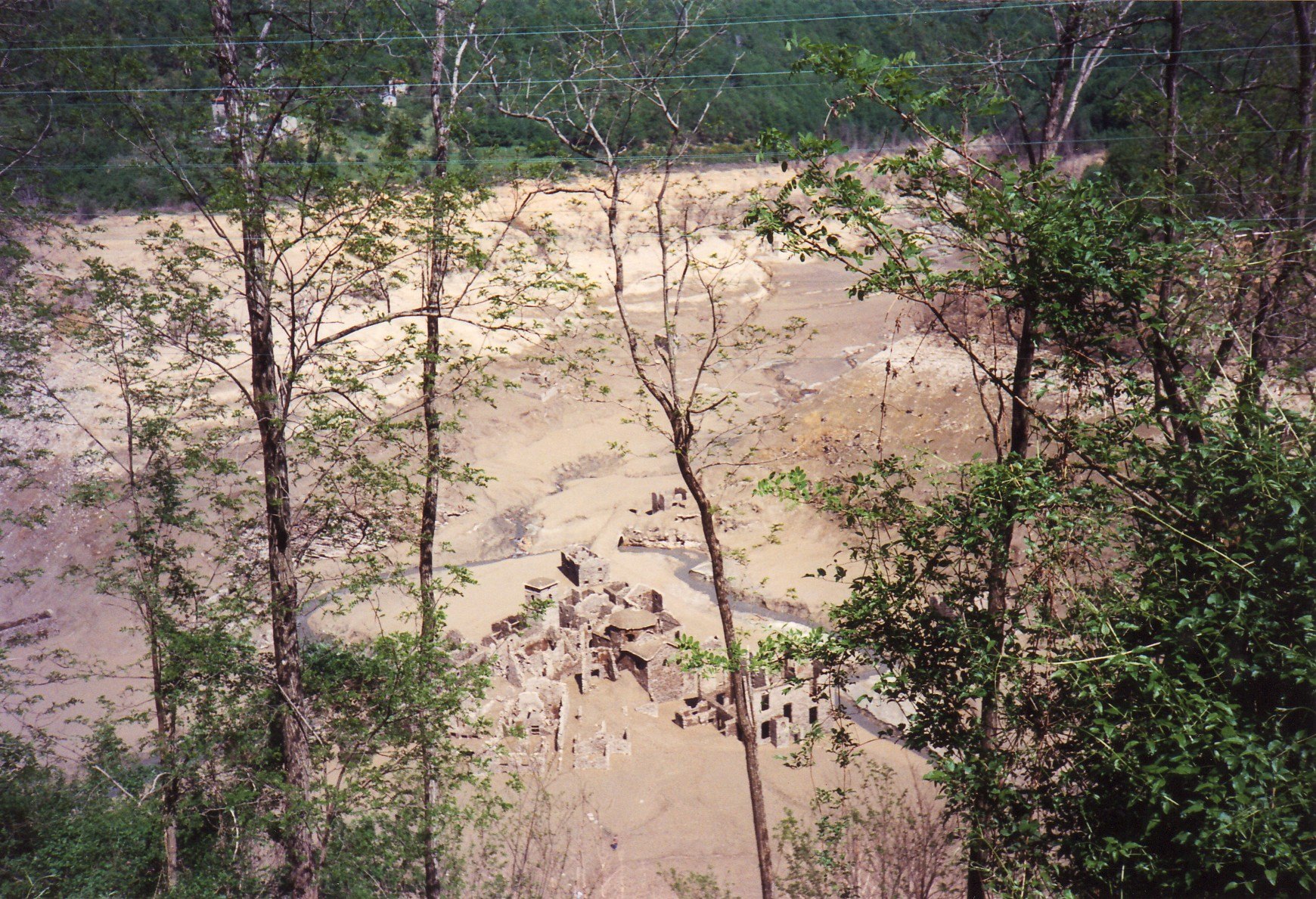
Up in the Apuan Alps, north of Lucca, there’s a lake with a village at the bottom of it. The village is Fabbriche di Careggine. The lake is Lago di Vagli. Every so often, the lake has been emptied and the village has come back up into the light: stone houses, a church, a little bridge, all grey with mud.
It has only happened a handful of times. The last was in 1994. I find it completely haunting, and I wanted to know everything: what it was, why it sank, and whether we’ll ever get to walk its streets again.

A village of ironworkers
Fabbriche di Careggine was founded in the 13th century by a colony of ironworkers from Brescia, in Lombardy. Hence the name: fabbriche means forges. It belonged to the comune of Careggine, on the slopes above.
Under the Este dukes of Modena it became one of the state’s main suppliers of iron, with its own mill. The Via Vandelli, the old road from Modena to Massa, crossed the Edron torrent right by the village, first on a wooden walkway and then on a stone bridge with three arches.
By the 1940s it was a small place. Just 31 houses and 146 people, with the church of San Teodoro and its square bell tower, a cemetery and that bridge.
The dam
In 1941 the electricity company SELT Valdarno (now part of Enel) began building a hydroelectric dam across the Edron, in the comune of Vagli Sotto. The war slowed the work down. The dam was finished in 1947, and between 1951 and 1953 it was raised by about 30 metres, to roughly 90 metres high.
The families of Fabbriche left in 1947 and were moved to new houses at Vagli Sotto. Then the water rose. The village went under, along with smaller hamlets further up the valley.

The times it came back
The lake is a working reservoir. In the past it was emptied for maintenance on the dam, roughly every ten years or so. Each time, Fabbriche di Careggine reappeared. The sources agree on four full drainings:
- 1958
- 1974
- 1983
- 1994, the last time so far
Before any of those, it peeped out once already. In August 1951, while the dam was being raised, the church tower and the top half of the village came up out of the water for a few days. An Istituto Luce newsreel filmed men rowing a boat between the empty houses. You can watch it below.
In 1994 nearly a million people came to see it, from all over Italy and from abroad. They walked down onto the lakebed, past the roofless houses, to the church and the old bridge. It must have been extraordinary.

You’ll sometimes read that it was drained in 1970 too. I couldn’t find any good source for that. The four full drainings above are the ones the sources agree on.
Watch it sink, and come back
Until the lake is emptied again, these videos are the next best thing: the village going under in 1947, peeping out in 1951 and coming back in 1994.
When will Lago di Vagli be drained again?
The short answer: nobody knows. As of November 2026 there is no confirmed date. Not from Enel, not from the Region of Tuscany. If you see a date online, treat it as a rumour until there’s an official announcement.
It has been promised, and put off, many times. Here’s the story so far:
- A draining was planned for 2016, then pushed back.
- Enel sent the Region a draining plan in November 2020. It was approved on 8 June 2021, for spring 2023.
- Then came the drought of 2022. On 30 May 2023 a regional decree moved it to spring 2024.
- In February 2024 Il Tirreno reported that 2024 was off too, because of water shortages.
- In March 2026 La Nazione reported plans for summer 2027. But it also said Enel no longer needs to empty the lake: the maintenance can now be done underwater. So any draining would be for visitors, and roads and car parks would need building first.
- In July 2026 the President of Tuscany, Eugenio Giani, said the Region was talking to Enel Green Power about 2028. He called it an “embryonic” stage, with nothing agreed. Finestre sull’Arte reported that the 2027 idea can be considered shelved.
- In August 2026 a former mayor of Vagli Sotto told La Nazione he hoped it wouldn’t happen at all, with the lake already 15 metres down in the drought.
So it may happen in 2028. It may not. I’ll update this post as soon as there’s anything official.
How to see it when the lake is full
You can’t see the village itself. But the lake is still well worth the drive. It’s a strange, beautiful place, a deep turquoise-green between steep mountains, and it doesn’t look like the Tuscany most people know.
Walk across Ponte Morandi
The slim concrete arch of Ponte Morandi crosses the lake from Vagli Sotto to the far shore. You can walk over it and look down into the water, and think about what’s under there.

The suspended bridge
A pedestrian suspension bridge also crosses the lake, opened on 19 June 2016. It has a glass section in the middle, so you can see the water under your feet. It’s run privately as part of Vagli Park, and you reach it on the lakeside walk. They say it’s open every day, but do check their website before you go, especially out of season.
The dam and the lakeside
The top of the dam is open to walk along all year, with a dizzying view down one side and the lake on the other. There’s a walk along the shore from the village too.
When the water is low
In long dry spells the lake drops, and things start to show. In the drought of autumn 2022 ruins reappeared, including an old mill. Most were the remains of Piari, a hamlet further up the Edron, and Fabbriche itself still had nearly 20 metres of water over it. So don’t expect to see the village. But a low lake, with the old banks bare and grey, is eerie in its own way.


A ghostly gallery
It’s at its most atmospheric out of season, in mist, low winter sun or snow. Here are some of the best free-licence photos I could find.


Best time to visit
- Spring and early summer for the lake full and the woods bright green.
- Summer if you want the private attractions running. It’s also the busiest time.
- Autumn for chestnut-gold woods. Water levels are often lower after a dry summer, though there’s no guarantee.
- Winter for the ghostly side: mist on the water, snow on the Apuan peaks, and hardly anyone about. Mountain roads can be icy, so check the forecast.
If a draining is ever confirmed, expect huge crowds. In 1994 nearly a million people came. Go early in the day and early in the season.
Getting there from Lucca
Vagli Sotto is about 65 km from Lucca by road. Allow around an hour and a half. Head north up the Serchio valley, past Borgo a Mozzano and its Devil’s Bridge, to Castelnuovo di Garfagnana, then follow the signs up into the mountains for Vagli. The last stretch is winding.
You really need a car. The Lucca to Aulla railway runs up the valley, but there’s no station anywhere near the lake.
Make a day of it. My guide to the Garfagnana covers the villages, castles and food on the way up. For more ideas, see my best day trips from Lucca, which comes with a FREE printable to take with you, and my Le Dieci Castella driving route through the Svizzera Pesciatina.
FAQs
Can you see the submerged village at Lago di Vagli now?
No, not while the lake is full. In very dry spells some ruins can show near the edges, but Fabbriche di Careggine itself lies in the deepest part and only reappears when the lake is emptied.
When will Lago di Vagli be drained next?
There is no confirmed date. In July 2026 the President of Tuscany said a draining in 2028 was being discussed with Enel Green Power, but only at an early stage and with nothing agreed. Earlier plans for 2016, 2023, 2024 and 2027 all fell through.
When was the lake last drained?
In 1994. Nearly a million people came to see the village.
How many times has the village reappeared?
Only a handful of times. The sources agree on four full drainings, in 1958, 1974, 1983 and 1994, and a 1951 newsreel shows it half out of the water for a few days while the dam was being raised.
Why was Fabbriche di Careggine flooded?
A hydroelectric dam was built across the Edron torrent between 1941 and 1947 and raised in the early 1950s. The villagers were moved to new houses at Vagli Sotto in 1947 and the valley was flooded.
How far is Lago di Vagli from Lucca?
About 65 km by road. Allow around an hour and a half by car.
Sources
Last checked: November 2026.
- “Per pochi giorni riemerso a salutare il sole Fabbriche di Careggine”, La Settimana Incom, 13 August 1951, Archivio storico Luce
- I “vaglini” a Gallicano, Adolfo Moni (L’Aringo di Gallicano, March 2019), on Daniele Saisi’s blog
- Diga di Vagli, Direzione generale per le dighe, Ministry of Infrastructure
- Fabbriche di Careggine, Wikipedia (Italian)
- Lago di Vagli, Wikipedia (Italian)
- La siccità svuota il lago di Vagli, Il Tirreno, 2 November 2022
- Riaffiorano ruderi dal lago di Vagli, NoiTV, 7 November 2022
- Forse potremo di nuovo visitare questo paese sommerso, Il Post, 4 July 2023
- Lago di Vagli, svuotamento: salta l’anniversario dei trent’anni, Il Tirreno, 26 February 2024
- Nel 2027 lo svaso del lago di Vagli, La Nazione, 10 March 2026
- Il borgo sommerso del Lago di Vagli potrebbe riemergere nel 2028, Finestre sull’Arte, 18 July 2026
- Vagli e la sua ‘città’ sommersa, La Nazione, 27 August 2026
- Vagli Sotto e il borgo sommerso di Fabbriche di Careggine, Lucca24, 24 October 2026
- Il ponte sospeso, Vagli Park
Susan
Photo credits: Fabbriche di Careggine on the drained lakebed, 1994, the header picture (photo: Nimue, CC BY-SA 4.0, via Wikimedia Commons). All the other photos are credited in their captions.