
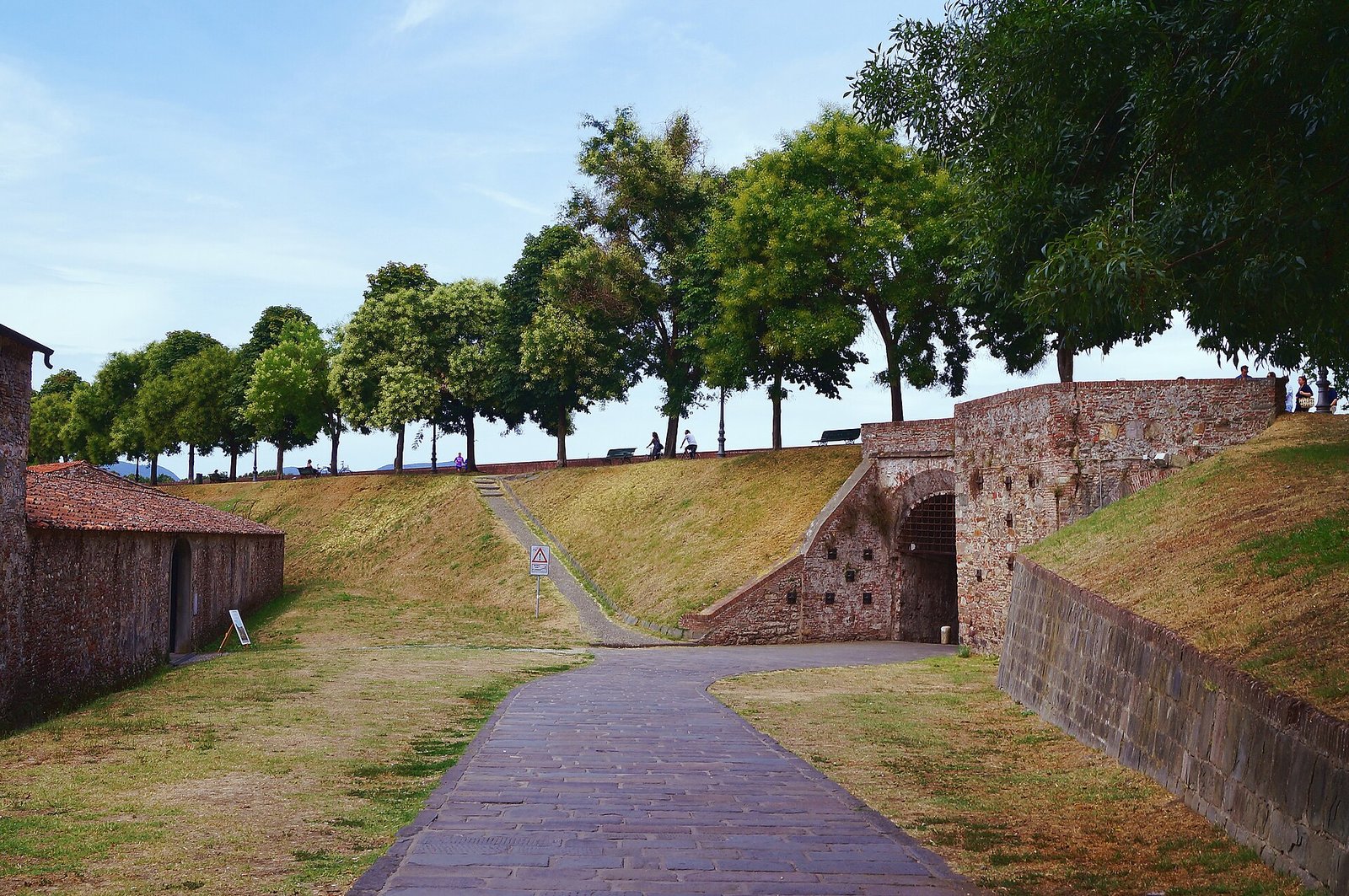
Lucca was part of my old patch, the stretch of Tuscany between Lucca, Pescia and Pistoia. It’s the only city I know where the best thing to do is ride round the top of the walls. On a bike. Under the trees. With half the town doing the same.
It’s flat, walkable and full of churches, with a railway station just outside the walls, so it’s an easy place to start. Here’s my guide to the city and the villages of its comune.

Lucca quick facts
- Province: Lucca (the city is the provincial capital)
- Population: 88,464 for the whole comune (ISTAT estimate, 1 January 2026)
- Altitude: about 19 metres
- Nearest station: Lucca, just outside the walls by Porta San Pietro
- Pistoia: about 45 km by road, roughly 40 minutes
- Florence: about 77 km by road, roughly an hour, or direct by train
Visiting Lucca
Getting to Lucca
Lucca is easy without a car. Trains run to Pisa, to Florence via Montecatini and Pistoia, to Viareggio for the beach, and up the Serchio valley towards Barga. From the station you can be on the walls in ten minutes: walk across the road and up through Porta San Pietro. If you do drive, the old town is a ZTL, so park outside the walls.
- Pisa or Florence airport to Lucca, Pescia and Pistoia
- Getting around Tuscany: trains, buses or driving?
- Trains, buses and how not to get fined
- Driving in Tuscany: ZTL zones, fines, tolls and car hire
Good to know
- Parking outside the walls. Parcheggio Carducci is €1 an hour from 8am to 8pm, free overnight, with a daily cap of €8. Parcheggio Palatucci is 50 cents for the first hour, then €1 an hour, also capped at €8. The Stazione car park by the station is €1 an hour, with the same €8 cap.
- Trains. Pisa is about 30 minutes away. Florence is about 1 hour 15 to 1 hour 35. Some Florence trains stop at Firenze Rifredi rather than Santa Maria Novella, so check which one you’re on.
Sources: Lucca Plus parking prices (checked October 2026), Trenitalia timetables (checked October 2026), and Lucca Comics & Games for the festival dates.
Best time to go
Spring and early autumn are lovely for walking the walls. Watch out for Lucca Comics & Games, which takes over the whole town every autumn (28 October to 1 November in 2026). It’s brilliant if that’s your thing and rammed if it isn’t, so book early or pick other dates. For something gentler, come for the Luminara on the evening of 13 September.
A short history of Lucca
Lucca started out as a Roman colony, founded in 180 BC, and you can still read the Roman town in its straight streets. The oval Piazza dell’Anfiteatro follows the line of the old Roman amphitheatre: the houses were built into its ruins, and in the 19th century the architect Lorenzo Nottolini cleared the middle to make the piazza we see today.
In the early Middle Ages it was the capital of the Lombard duchy of Tuscia, and the Volto Santo, the carved crucifix in the cathedral, made it a stop for pilgrims on the Via Francigena. It grew rich on trade and silk, and it stayed an independent republic for centuries, holding off Florence, until the French arrived in 1799.
Napoleon’s sister Elisa ruled it as a principality from 1805. After her came Maria Luisa of Bourbon, then her son, until Lucca was handed to the Grand Duchy of Tuscany in 1847. The great Renaissance walls, about 4.2 km round, are still complete, one of only a handful of intact circuits in Italy. Built to keep armies out, today they keep the cars out, and they’re the city’s favourite park.
What to see in Lucca
The walls. A flat loop of about 4.2 km on top of the Renaissance walls, shaded by big plane and lime trees, free and open all year. Hire a bike near Piazza Santa Maria and go round. Early morning is my favourite. It’s all in my post on Lucca’s walls by bike.
Piazza dell’Anfiteatro. The oval piazza built into the Roman amphitheatre. Come in through one of the low archways and it opens up around you.
The cathedral of San Martino. Home of the Volto Santo, the ancient carved crucifix that pilgrims came to see. On the evening of 13 September the whole city follows it by candlelight in the Luminara di Santa Croce.
San Michele in Foro. The church on the site of the Roman forum, with a tall, lacy marble front stacked with little columns. Lucca has a church on nearly every corner, and they make perfect shelter on a wet day.
The Guinigi tower. The tower with oak trees growing on top. You’ll spot it from the walls, and you can climb it for the view over the roofs.
Puccini’s birthplace. Giacomo Puccini was born in Lucca, in Corte San Lorenzo, and the house is now the Puccini Museum, with his piano, letters and scores. Fans should also go up to Celle dei Puccini, the family home in the hills.
The markets. The weekly market is on Wednesday and Saturday mornings just outside the walls, and the antiques market fills the streets round Piazza San Martino on the third weekend of every month. More in my Tuscany market days guide.
Rainy day? Try my rainy day ideas near Lucca, Pescia and Pistoia.


The villages of Lucca
The comune of Lucca covers about 186 square kilometres, far more than the walled city. It spreads out across the plain and up into the hills to the north and west, with dozens of small villages and hamlets, many with a church, a few houses and a view.
For villages further out, my best day trips from Lucca and my guide to the Garfagnana, the mountain valley north of the city, are the places to start. 8 small villages in Tuscany you’ve probably never heard of has a few more. And these are the villages near Lucca I think are most worth the trip.
All the villages of Lucca (91)
A Bertolacci, Ai Borelli, Al Molinaccio, Al Mutino, Alla Bidia, Antraccoli, Aquilea, Arancio, Arliano, Arsina, Balbano, Cappella, Carignano, Castagnori, Castiglioncello, Cerasomma, Chiatri, Ciciana, Convento dell’Angelo, Convento di San Cerbone, Corte Bertolotti, Croce, Deccio di Brancoli, Fagnano, Farneta, Gattaiola, Il Colle, Il Sanatorio, Maggiano, Massa Pisana, Mastiano, Meati, Monte San Quirico, Monti di Chiatri, Montuolo, Mutigliano, Nave, Nozzano, Nozzano San Pietro, Nozzano Vecchia, Ombreglio, Ombreglio di Brancoli, Orzala, Palmata, Piaggione, Piazza di Brancoli, Piazzano, Picciorana, Pieve di Brancoli, Pieve Santo Stefano, Ponte a Moriano, Ponte del Giglio, Ponte della Maddalena, Ponte San Pietro, Pontetetto, Querce, Saltocchio, San Concordio di Moriano, San Donato, San Filippo, San Gemignano, San Giusto di Brancoli, San Lorenzo a Vaccoli, San Lorenzo di Moriano, San Macario in Monte, San Macario in Piano, San Michele di Moriano, San Pietro a Vico, San Quirico di Moriano, Santa Maria a Colle, Santa Maria del Giudice, Sant’Alessio, Sant’Angelo in Campo, Sant’Ilario, Sant’Ilario di Brancoli, Santissima Annunziata, Santo Stefano di Moriano, Selve, Sorbano del Giudice, Sorbano del Vescovo, Stabbiano, Tempagnano di Lunata, Torre, Torre Alla Maddalena, Tramonte, Tramonte di Brancoli, Vecoli, Vicopelago, Villa, Villa Valenti, Vinchiana
For the neighbouring towns, see Villages of Lucca province.
Food and festas
Lucca’s own pasta is tordelli lucchesi, big half-moons stuffed with meat and served with a meat ragù. It’s tordelli with a “d”, not tortelli, and the people of Lucca will tell you so. In spring look for garmugia, a soup of the first broad beans, peas, artichokes and asparagus. And there’s buccellato, the ring-shaped sweet bread with raisins: the old saying goes that if you come to Lucca and don’t eat it, it’s as if you’d never been. If you’d like to make tordelli at home, here’s my tordelli lucchesi recipe.
The big nights are the Luminaras. On 11 July, for San Paolino, and on 13 September, for Santa Croce, the lights go off and the city fills with candles, with a crossbow palio the next day. Dates are in my Tuscany’s big festivals post, and for what to order, see what to eat in the Lucca and Pistoia hills.
Where to stay
In and around Lucca
A Booking.com search for Lucca: hotels, B&Bs and apartments. Just add your dates.
If you book through this link, I may earn a small commission at no extra cost to you. It helps keep this site going.
Lucca is one of the best bases in Tuscany if you don’t want to drive, with trains in every direction. For the bigger picture, my where to stay in Tuscany guide weighs up villages, towns and agriturismi, and where to stay near Lucca and the Svizzera Pesciatina covers my old patch.
Useful numbers
In any emergency, call 112. Lucca’s hospital is the Ospedale San Luca, on Via Guglielmo Lippi Francesconi in San Filippo, with a 24-hour Pronto Soccorso (A&E).
Every other number you might need, from the doctor to the train strike line, is in my useful numbers in Tuscany post.
Map
Lucca is one of the towns of Lucca province. See Lucca on the Lucca page, or browse all of Villages of Tuscany.
Susan x
Photo credits: Piazza dell’Anfiteatro, built on the old Roman arena (photo: Zairon, CC BY 4.0, via Wikimedia Commons); San Michele in Foro (photo: Spike, CC BY-SA 4.0, via Wikimedia Commons).