
Montecatini Terme was one of the stops on my line, the railway that ties our patch to Florence: Lucca, Pescia, Montecatini, Pistoia, Prato, Firenze Santa Maria Novella. It’s the grand old spa town of the Valdinievole, all parks and elegant buildings.
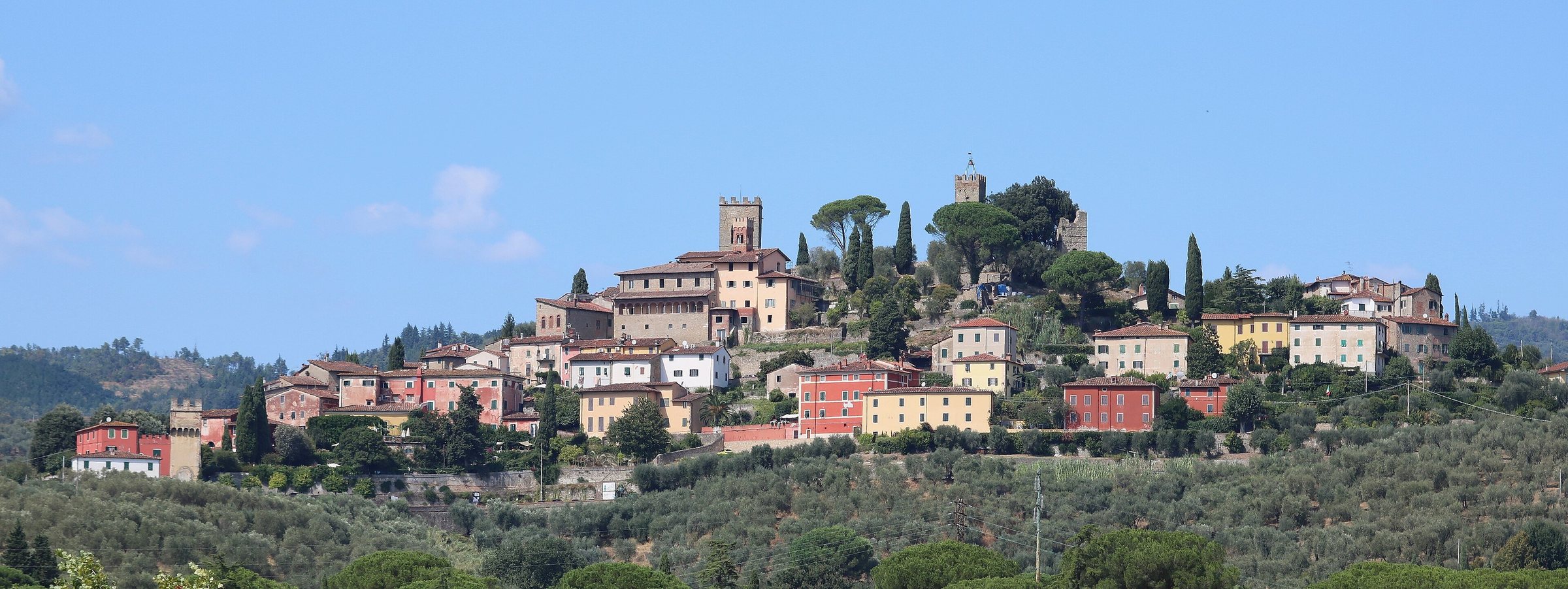
Above it, on its hill, is the old village of Montecatini Alto, and a little red funicular has been carrying people up there since 1898. Here’s my guide to the funicular and Montecatini Alto.
Montecatini Terme quick facts
- Province: Pistoia
- Population: 21,805 (ISTAT estimate, 1 January 2026)
- Altitude: about 29 metres in the spa town, with Montecatini Alto on the hill above
- Nearest station: Montecatini Terme, on the Florence to Lucca line, in the town
- Lucca: about 33 km by road, roughly half an hour
- Pistoia: about 17 km by road, roughly 20 minutes
- Florence: about 47 km by road, roughly 40 minutes
Visiting Montecatini Terme
Getting to Montecatini Terme
Montecatini is easy by train, on the line between Florence and Lucca, so you don’t need a car. Monsummano and Grotta Giusti are a short taxi ride away. Pisa and Florence airports are both about the same distance, so pick the cheapest or best-timed flight.
- Pisa or Florence airport to Lucca, Pescia and Pistoia
- Getting around Tuscany: trains, buses or driving?
- Trains, buses and how not to get fined
- Driving in Tuscany: ZTL zones, fines, tolls and car hire
Good to know
- The funicular. The little red funicular up to Montecatini Alto has been running since 1898. The bottom station is at Via Armando Diaz 22. Cars leave every 30 minutes from 9.30am to midnight, from late March to the start of November (21 March to 1 November in 2026). It’s €4 one way or €7.50 return. Keep your ticket, because you need it for the way back.
- Out of season the funicular doesn’t run, so you’ll need to drive up to Montecatini Alto.
Sources: Funicolare di Montecatini and the Comune di Montecatini Terme, checked October 2026.
Best time to go
Late March to early November, while the funicular’s running. An evening ride up to Montecatini Alto is a treat in summer.
A short history of Montecatini Terme
For most of its history the town was the castle on the hill, today’s Montecatini Alto, a border fortress that saw more than its share of battles. In 1554, after Sienese and French troops held out there against Cosimo I de’ Medici, he had the castle dismantled. Down on the plain were marshes and a few old baths, known since the Middle Ages but hard to reach and plagued by malaria.
The spa town was really the work of Grand Duke Pietro Leopoldo, who came here in 1772, drained the land and rebuilt the bathhouses. In the 19th and early 20th centuries the grand terme, hotels and parks went up, and the funicular to the castle opened in 1898. Two of the old baths, the Bagno Regio and the Bagno dei Merli, became the Tettuccio and the Leopoldine, names you’ll still see today, and between 1904 and 1915 the Torretta and the Excelsior were added.
In 1905 the spa became a comune of its own, Bagni di Montecatini, and in 1928 it took the name Montecatini Terme and moved from Lucca’s province to the new province of Pistoia. In 2021 it joined UNESCO’s list as one of the Great Spa Towns of Europe, alongside places like Bath, Baden-Baden and Vichy.
What to see in Montecatini Terme
The terme and the parks. The big spa buildings, set in the green of the thermal park, are the reason the town exists. Even if you don’t take the waters, a walk through the park and along the grand avenues gives you the feel of the place.
Viale Verdi. The grand avenue of the spa town, lined with the old terme and hotels. In its heyday the town drew aristocrats, film stars and politicians, and the Montecatini Walk of Fame on Via Verdi remembers them.
The funicular to Montecatini Alto. The little red funicular runs from town up to the old hill village. It’s seasonal, so check it’s running before you go.
Montecatini Alto. Up top there’s a piazza with cafés and a view right across the Valdinievole.
Taking the waters. Book a spa treatment, or just wander and have a hot chocolate somewhere grand. Grotta Giusti at Monsummano Terme, just down the road, is a spa built around a natural thermal cave, where you sit in warm steam deep underground. Book ahead. My Tuscany’s hot springs post has the details.
The market. Thursday morning, at Piazzale Granduca Leopoldo. More in Tuscany market days.


The villages of Montecatini Terme
The comune is small, only about 18 square kilometres, and mostly town. The village that matters is Montecatini Alto, on its hill, with a handful of hamlets around it. For hill villages, head west to the ten castle villages above Pescia, which have their own Pescia guide.
All the villages of Montecatini Terme (6)
Biscolla, Gallo, Montecatini Alto, Nievole, Renaggio, Vico
For the neighbouring towns, see Villages of Pistoia province.
Food and festas
The thing to try here is the cialda di Montecatini, a big, thin wafer with almonds. Perfect with a coffee. Look out too for brigidini di Lamporecchio, thin, crisp aniseed wafers from just down the road. You’ll see them at every fair. For the wider area, see what to eat in the Lucca and Pistoia hills, and for festas nearby, my sagre and festivals month by month.
Where to stay
In and around Montecatini Terme
A Booking.com search for Montecatini Terme: hotels, B&Bs and apartments. Just add your dates.
If you book through this link, I may earn a small commission at no extra cost to you. It helps keep this site going.
Montecatini has a lot of hotels, and makes a quieter base on the line between Florence and Lucca. For the bigger picture, my where to stay in Tuscany guide weighs up villages, towns and agriturismi, and where to stay near Lucca and the Svizzera Pesciatina covers my old patch.
Useful numbers
In any emergency, call 112. The nearest hospital with a 24-hour Pronto Soccorso (A&E) is the Ospedale SS. Cosma e Damiano in Pescia, Via Cesare Battisti 2.
Every other number you might need, from the doctor to the train strike line, is in my useful numbers in Tuscany post.
Map
Montecatini Terme is one of the towns of Pistoia province. See Montecatini Terme on the Pistoia page, or browse all of Villages of Tuscany.
Susan x
Photo credits: Gigia, one of the two funicular cars (photo: Minnitre, CC BY-SA 4.0, via Wikimedia Commons); The Tettuccio spa (photo: HauchnebelkabinetT, CC BY-SA 4.0, via Wikimedia Commons); header photo: Montecatini Alto on its hilltop (photo: Ingo Mehling, CC BY-SA 4.0, via Wikimedia Commons).
