
Pisa is where most of us fly in, and from Lucca it’s a short, direct train ride. Most people do it like this: train, Tower, silly photo holding it up, back on the train. Forty minutes, done.
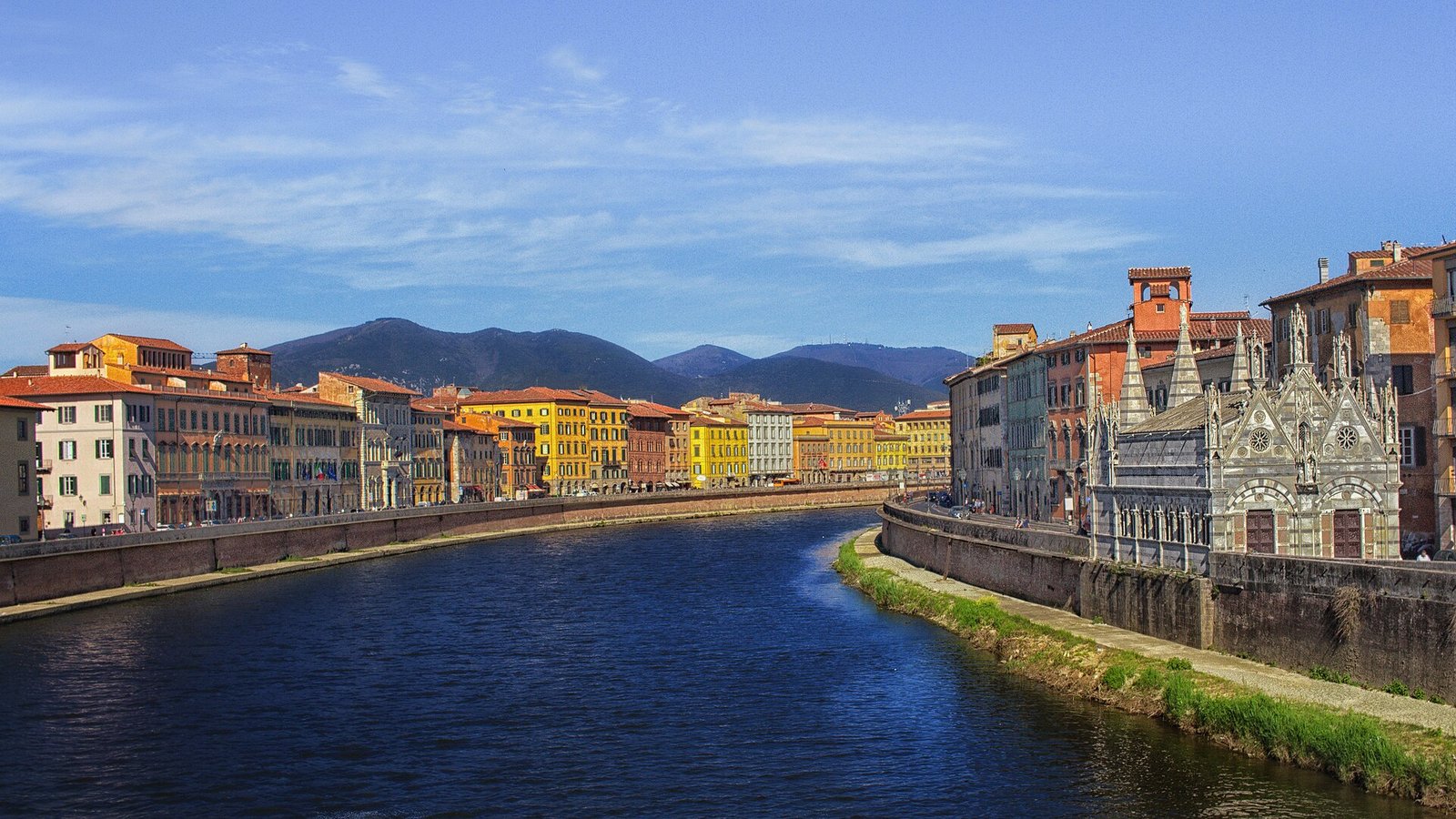
They miss the rest of the city, and the rest of the city is lovely: a real university town on a wide bend of the Arno, full of students, bikes, markets and old palaces the colour of apricots. Here’s my guide to Pisa and the villages of its comune.

Pisa quick facts
- Province: Pisa (the city is the provincial capital)
- Population: 90,146 for the whole comune (ISTAT estimate, 1 January 2026)
- Altitude: about 4 metres, on the Arno a few kilometres from the sea
- Stations: Pisa Centrale, and Pisa San Rossore, the closest to the Tower
- Lucca: about 20 km by road, roughly half an hour, or direct by train
- Florence: about 98 km by road, roughly an hour and a quarter, or direct by train
Visiting Pisa
Getting there and parking
Pisa is easy. The airport, Galileo Galilei, is the main one for this side of Tuscany, and the PisaMover shuttle train runs from it to Pisa Centrale in a few minutes. From Lucca the train stops at Pisa San Rossore, the closest station to the Tower, then Pisa Centrale. The walk between the two takes you right through the middle. There are direct trains to Florence and along the coast too. Don’t drive into the centre: it’s a ZTL.
- Pisa or Florence airport to Lucca, Pescia and Pistoia
- Getting around Tuscany: trains, buses or driving?
- Transport in Italy: trains, buses and how not to get fined
- Accessible Tuscany: honest tips for wheelchair users
Good to know
- PisaMover. The shuttle from the airport to Pisa Centrale takes about 5 minutes. It runs every day from 6am to midnight, and until 1am from 1 June to 30 September. It’s €6.50 one way or €13 return.
- Climbing the Tower. Tickets are for a set time and go on sale online up to 90 days ahead. Only Visa and Mastercard are accepted. The climb takes about 30 minutes and there are 251 steps. Bags go in the cloakroom first.
- Children. Under-8s can’t go up. Children who are 8, or turn 8 this year, can. Under-18s must be with an adult. There are no reduced tickets.
- Don’t be late. You can change or cancel up to 2 hours before. Miss your slot and you lose the visit and the money.
- Trains. Lucca to Pisa San Rossore takes 20 to 28 minutes. Pisa Centrale to Livorno is 13 to 19 minutes, and to Florence Santa Maria Novella about 50 minutes to 1 hour 20.
Sources: PisaMover, Opera della Primaziale Pisana and Trenitalia timetables (checked October 2026).
A short history of Pisa
Pisa is old. The Romans knew it as Pisae, and it became a Roman colony, but the city’s great age came in the Middle Ages, when it was one of the maritime republics, alongside Genoa, Venice and Amalfi. Its ships traded across the Mediterranean, and its own style of Romanesque building, born with the cathedral, spread as far as Corsica and Sardinia.
The money built the Piazza dei Miracoli. The cathedral was begun in 1063, and the bell tower followed, built in three stages over two centuries. The ground under it was soft, and it started to lean.
The end of Pisa’s sea power came at the battle of Meloria in 1284, when Genoa defeated its fleet. From the 15th century the city was ruled by Florence. The university was founded in 1343, Galileo was born here in 1564, and today Pisa is still a student town. The Piazza del Duomo has been on UNESCO’s World Heritage list since 1987.
What to see in Pisa
The Piazza dei Miracoli. The cathedral, the Baptistery, the Camposanto and the Tower, white marble on a green lawn. Climb the Tower if you like (book a timed ticket), take the photo, then walk away from the crowds. No children under 8 are allowed up the Tower, so check before you promise.
Keith Haring’s Tuttomondo. Near Pisa Centrale, on the back wall of the convent of Sant’Antonio Abate, is a huge, joyful mural that the American artist painted in 1989. It’s free, it’s outdoors, and hardly anyone coming for the Tower knows it’s there.
The Lungarni and Santa Maria della Spina. The riverside streets along the Arno, lined with old palaces. Walk them at sunset. On the south bank is Santa Maria della Spina, a tiny Gothic church covered in spires, like a little stone jewellery box.
Piazza dei Cavalieri. Once the political heart of the city. The Palazzo della Carovana, with its black and white graffito front, was remodelled by Giorgio Vasari and is now home to the Scuola Normale Superiore. Students sit on the steps.
The old ships museum. In 1998, digging near San Rossore station turned up the remains of ancient ships in the mud of an old harbour. They’re now in the Museo delle Navi Antiche, in the Medici shipyards on the river. Good for a rainy day, or for children.
The botanic garden. The Orto Botanico, founded in 1543 by Luca Ghini, is one of the oldest university botanic gardens in Europe. Old trees, glasshouses and shady paths, just round the corner from the Tower.
More in my post on Pisa beyond the Leaning Tower, and if it rains, try my rainy day ideas.


The villages of Pisa
The comune of Pisa runs right down to the sea, with the seaside villages of Marina di Pisa, Tirrenia and Calambrone, and the old basilica of San Piero a Grado on the way. Marina di Pisa is the easiest bit of sea from the city. Inland is the San Rossore estate, part of the regional park of Migliarino, San Rossore and Massaciuccoli.
For real hill villages, head north to the Monte Pisano. 8 small villages in Tuscany you’ve probably never heard of has a few ideas, and Vicopisano is on the Pisa province page, under its own comune.
All the villages of Pisa (32)
Argine, Azienda Agricola Tirrenia, Barbaricina, Cascine Nuove, Cascine Vecchie, Case Guidotti, Coltano, Coltano Radio, Corte Vivaldi, Cresam, Fagiana Sud, La Bigattiera, La Punta, La Vettola, Luicchio, Maggiore Oratoio, Marina di Pisa, Marina di Pisa – Tirrenia – Calambrone, Palazzi, Pierdicino, Porta a Mare, Pratale, Putignano Pisano, San Biagio, San Iacopo, San Piero a Grado, Sant’Ermete, Scuderie Nuove, Stagno, Tirrenia, Tombolo, Villa Filippi
For the neighbouring towns, see Villages of Pisa province.
Food and festas
Pisa’s street food is cecina, a thin, crisp flatbread made with chickpea flour, eaten hot. The sweet to look for is torta co’ bischeri, a rice and chocolate tart with its pastry edge pinched into points. At Easter there’s schiacciata di Pasqua, a tall, soft sweet bread flavoured with aniseed. Lovely with a coffee.
Pisa throws two big parties on the river in June. On the evening of 16 June, the Luminara di San Ranieri, thousands of candles light up the palaces along the Arno, with a rowing race the next day for the patron saint. On the last Saturday of June the Gioco del Ponte, a historic trial of strength, is fought on the Ponte di Mezzo. Dates are in my Tuscany’s big festivals post.
Where to stay
In and around Pisa
A Booking.com search for Pisa: hotels, B&Bs and apartments. Just add your dates.
If you book through this link, I may earn a small commission at no extra cost to you. It helps keep this site going.
Pisa is handy for the airport and the coast, and cheaper than Florence. Lucca, half an hour away, is quieter. For the bigger picture, my where to stay in Tuscany guide weighs up villages, towns and agriturismi, and where to stay near Lucca and the Svizzera Pesciatina covers my old patch.
Useful numbers
In any emergency, call 112. Pisa’s main hospital is Cisanello (Azienda Ospedaliero-Universitaria Pisana), Via Paradisa 2, with a 24-hour Pronto Soccorso (A&E).
Every other number you might need, from the doctor to the train strike line, is in my useful numbers in Tuscany post.
Map
Pisa is one of the towns of Pisa province. See Pisa on the Pisa page, or browse all of Villages of Tuscany.
Susan x
Photo credits: Santa Maria della Spina on the Arno (photo: Ray in Manila, CC BY 2.0, via Wikimedia Commons); The Palazzo della Carovana, Piazza dei Cavalieri (photo: Ray in Manila, CC BY 2.0, via Wikimedia Commons); The cathedral and the Tower in the Piazza dei Miracoli (photo: Suicasmo, CC BY-SA 4.0, via Wikimedia Commons); The Tower lit up at dusk (photo: Thomas Fuhrmann Jakobsthal, CC BY-SA 4.0, via Wikimedia Commons).