
Volterra stands alone on a high ridge between the Era and Cecina valleys, a walled town of grey stone with nothing around it but rolling hills. It’s one of the three hill towns in my post on San Gimignano, Volterra and Pienza, and it’s the one that feels least changed.
It’s Etruscan, Roman, medieval and Medici all at once, and it’s still a town of alabaster workers. Here’s my guide to Volterra and the villages of its comune.

Volterra quick facts
- Province: Pisa
- Population: 9,362 for the whole comune (ISTAT estimate, 1 January 2026)
- Altitude: about 531 metres
- Station: none in town; the nearest railway runs along the valleys below
- Siena: about 52 km by road, roughly an hour
- Pisa: about 65 km by road, roughly an hour and a quarter
- Florence: about 77 km by road, roughly an hour and 20 minutes
A short history of Volterra
Volterra was Velathri, one of the twelve great cities of the Etruscans. Its walls, much longer than the town today, enclosed fields as well as houses, and the Porta all’Arco, a gate with three carved heads, still stands in them from the 4th century BC.
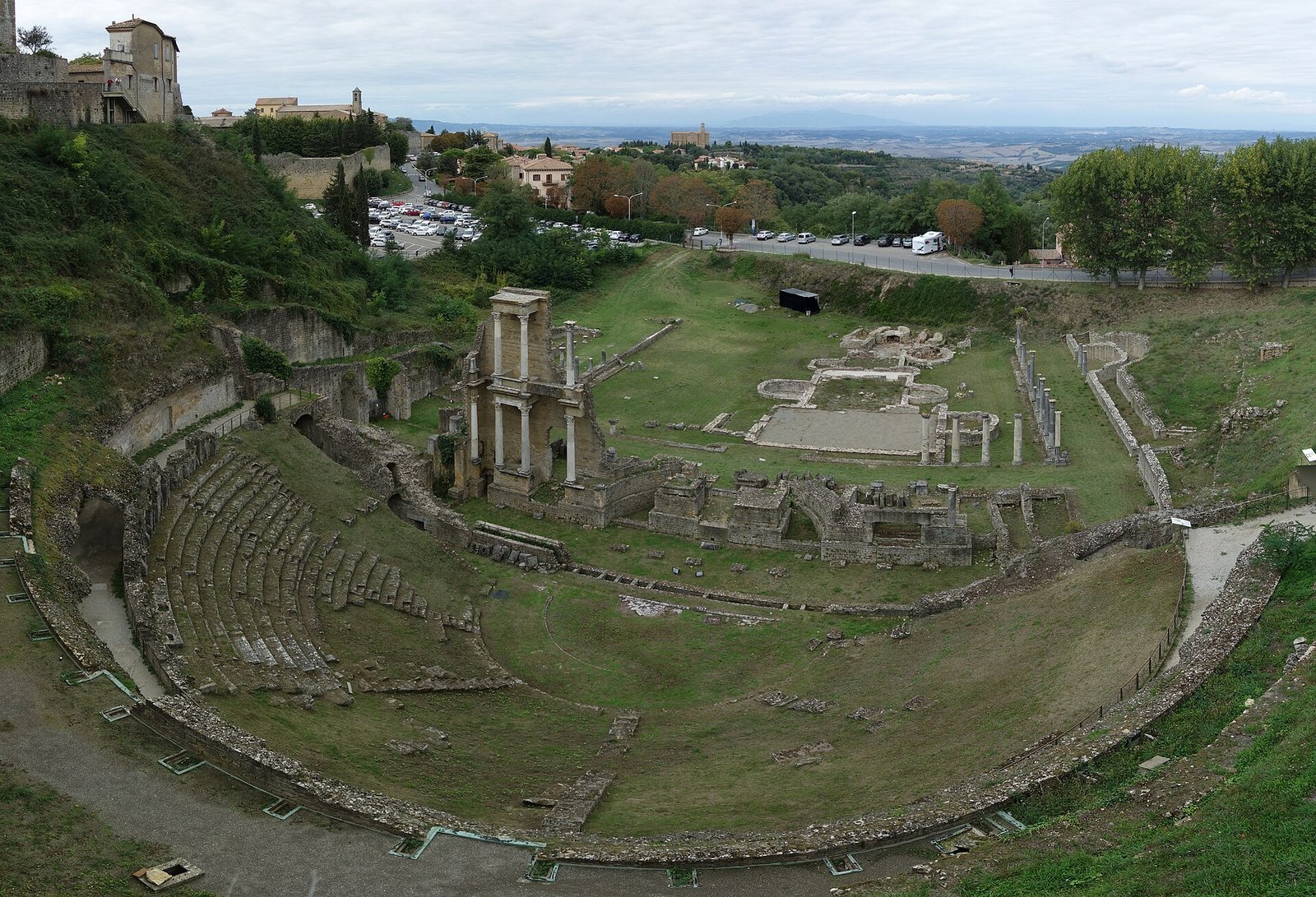
Under Rome it became Volaterrae, and the theatre below the walls was built at the end of the 1st century BC. It was buried and forgotten until it was excavated in the 1950s, and more recently a Roman amphitheatre was found nearby.
In the Middle Ages Volterra was a free comune, and the Palazzo dei Priori, begun in 1208, is said to be the oldest town hall in Tuscany. Its wealth came partly from salt and alum, and the alum mines led to its downfall: in 1472, in a dispute over the mines, Florence under Lorenzo il Magnifico besieged and sacked the town. The Medici then built the Fortezza, with the great round tower, the Mastio, which is still a prison.
What to see in Volterra
Piazza dei Priori. The main square, closed in by the Palazzo dei Priori and other medieval buildings. Sit and look.
The Guarnacci museum. One of the oldest public museums in Europe, founded in 1732, full of Etruscan ash urns in alabaster and stone. Its star is the Ombra della Sera, a tall, thin bronze figure that looks strikingly modern.
The Roman theatre. Seen best from the walkway along the walls above, or go down and in.
The Porta all’Arco. The Etruscan gate, with its three worn heads.
Alabaster. Volterra has worked alabaster since Etruscan times. Visit the Ecomuseo dell’alabastro, then the workshops in the old town, where you can watch the craftsmen.
The Pinacoteca and the Balze. The art gallery in Palazzo Minucci-Solaini, and, on the west side of town, the Balze: dramatic eroded cliffs where the ground has been falling away for centuries, taking churches and parts of the Etruscan walls with it.
If you’ve read Twilight, the Volturi live in Volterra, though the film was shot in Montepulciano. There are rainy-day ideas in rainy day ideas.
The villages of Volterra
The comune of Volterra is big, over 250 square kilometres, and mostly empty hills, fields and woods. Saline di Volterra, down in the Cecina valley, grew up around the salt works, and from 1912 to 1958 a rack railway climbed from there up to the town. Mazzolla and Villamagna are small hamlets in the countryside, and the hills to the south lead towards Larderello and its geothermal power.
For more hill villages in this part of Tuscany, see 8 small villages in Tuscany you’ve probably never heard of, and for wine, Tuscany’s wine villages.
All the villages of Volterra (15)
Cozzano, Il Cipresso, Mazzolla, Montebradoni, Pignano, Ponsano, Prato d’Era, Roncolla, Saline, San Cipriano, San Lorenzo, Sensano, Tignano, Ulignano, Villamagna
For the neighbouring towns, see Villages of Pisa province.
Food and festas
Up here it’s inland, hill-country food: soups, game, cured meats and pecorino, rather than fish. Ask what’s in season, and look out for the local sagre in autumn in sagre month by month.
Volterra has two festivals worth planning around. Volterra A.D. 1398, on the second and third Sundays of August, turns the town back to the Middle Ages, with costumes, crafts and food. The Astiludio, on the first Sunday of September, is a flag-throwing display in Piazza dei Priori. More in Tuscany’s big festivals.
Getting to Volterra
Volterra is best by car. There’s no train to the town itself, and buses run, but they’re slow and need planning, so check times before you rely on them. Park outside the walls: the centre is a ZTL. From Lucca or Pescia it’s a long day trip, so start early.
- Driving in Tuscany: ZTL zones, fines, tolls and car hire
- Getting around Tuscany: trains, buses or driving?
- Tuscany without a car
- Best day trips from Lucca
Where to stay
Volterra is quiet in the evening once the day visitors leave, and that’s when it’s at its best. For the bigger picture, my where to stay in Tuscany guide weighs up villages, towns and agriturismi, and where to stay near Lucca and the Svizzera Pesciatina covers my old patch.
Useful numbers
In any emergency, call 112. The main hospital for the province is Cisanello in Pisa (Azienda Ospedaliero-Universitaria Pisana), Via Paradisa 2, over an hour away. In an emergency, 112 will send help to the nearest service.
Every other number you might need, from the doctor to the train strike line, is in my useful numbers in Tuscany post.
Map
Volterra is one of the towns of Pisa province. See Volterra on the Pisa page, or browse all of Villages of Tuscany.
Susan x